
2026-09-02T10:18:28.836Z ·
Passive vs. Active Radon Systems: Why Most York County Homes Need the Fan
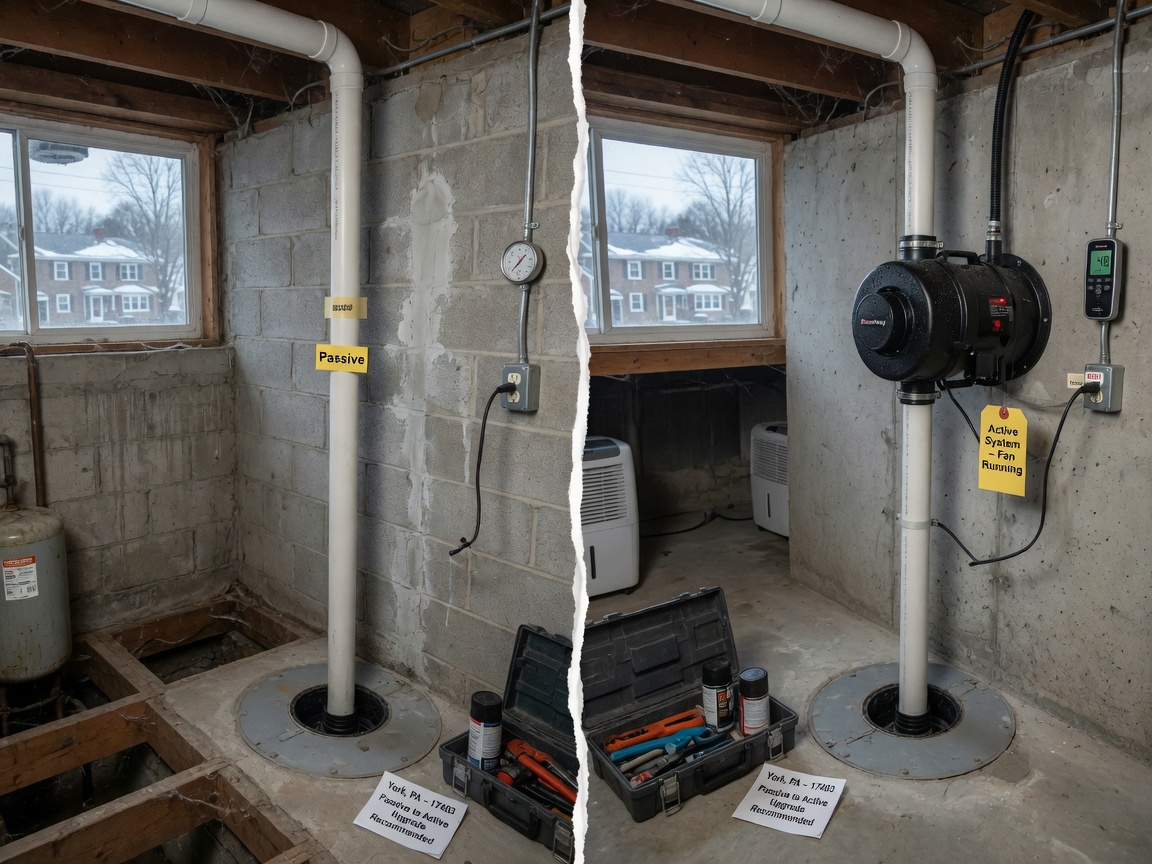
If you bought a new-construction home in a York County subdivision built in the last fifteen years — in Springettsbury, York Township, Penn Township near Hanover, Dover Township or Manchester — there is a good chance a 3-inch PVC pipe labeled 'radon' runs from your basement floor up through the roof. That is a passive radon system, and understanding what it can and cannot do saves a lot of confusion.
A passive system is a sub-slab suction pipe without a fan. It relies on the stack effect — warm air rising through the pipe — to draw a little soil gas from under the slab and vent it above the roof. Builders install it because the International Residential Code's radon-resistant construction appendix recommends it in high-radon areas, and because it makes future activation cheap. It typically reduces radon by 30 to 50 percent, which helps a house that would have tested at 5 but does nothing useful for a house that would have tested at 15.
York County is EPA Zone 1, with basement averages well above 4.0 pCi/L, so a passive stack alone rarely brings a home under the action level. We regularly test passive-system homes in Springettsbury and York Township at 5 to 10 pCi/L. The fix is simple: an inline fan spliced into the existing pipe, usually in the attic where the builder left the stub, a manometer on the basement section, and a post-mitigation test. Activation typically runs $500 to $800 — a fraction of a full install — and takes about two hours.
Active systems, by contrast, use a continuously running fan to hold a real vacuum under the slab, and they are what every retrofit installation in an existing home uses. They typically bring York County homes from 8–20 pCi/L down to 0.5–2.0. The fan costs $3–$10 a month to run and lasts 8 to 12 years.
If your home has a passive pipe and you have never tested, book a radon test. If the result is above 4.0 — or above 2.0 and you want it lower — activating the pipe is one of the best value radon jobs there is. If you're not sure whether your new home has a rough-in, look for a capped or roof-terminated 3-inch PVC pipe in the basement near the sump or along a foundation wall, usually with a 'radon system' sticker.